The League Dating App Review and the Real Cost of Its Exclusive Dating Model
LinkedIn’s ambition and Tinder’s ego were bound to collide eventually. The result is a dating app where education, career, verification, and professional ambition become part of the screening process. In this the league dating app review, the interesting question is whether that selectivity actually creates better dating conversations or simply turns social status into another dating currency.
The League has built its identity around busy, ambitious singles who supposedly do not have time for endless swiping. Instead of an unlimited feed, members receive a limited daily batch of potential matches, with the algorithm attempting to prioritize people who fit each other’s preferences. The company says more than half of its members attended top-40 colleges, around 30% have advanced degrees, and roughly a quarter hold executive or director-level positions.
That sounds impressive on paper. But dating is not a résumé contest.
The real test is whether all this filtering produces something more valuable than a polished profile: better conversations, more compatible dates, and fewer hours wasted on people who were never a realistic match.
1. The League Dating App Review Starts With the Waitlist and LinkedIn Screening
The first thing that separates The League from ordinary dating apps is the door.
You do not simply download it, upload three photos, and immediately start swiping through hundreds of profiles. The League uses a waitlist and a review process designed to control who enters the community. The company says members can review and vote on applications, while verification can use LinkedIn, Doximity, educational email, or corporate email.
That makes the application itself part of the product.
Why LinkedIn became part of the dating profile
LinkedIn verification is not there just to make a profile look more credible.
The League says LinkedIn can automatically import education and profession information and can also help hide users from coworkers. Users can control which education and profession details appear publicly.
For professional singles, that creates a useful layer of context before the first message.
You can get an idea of someone’s professional world without forcing them to write a dating bio that sounds like a corporate résumé.
But there is an obvious downside.
Career information can easily become a proxy for social worth.
The waitlist is both a filter and a psychological trick
The League says its waitlist exists to keep the community balanced and highly engaged. Wait times depend on factors including profile completeness, demand in a user’s location, and interest from other members. Subscribers and certain endorsed applicants receive priority.
There is a clever business mechanism here.
People tend to value access more when access is restricted.
A waitlist makes the app feel like something you qualify for rather than something you casually download. The League itself now openly describes the waitlist as an intentional part of the experience, arguing that the process encourages users to think more carefully about what they want.
That does not automatically make the dating pool better.
It does make the product feel more exclusive.
Does the screening actually mean better people?
This is where the marketing needs some skepticism.
Being highly educated, professionally successful, or ambitious does not tell you whether somebody is kind, emotionally available, funny, loyal, or capable of maintaining a healthy relationship.
The League itself says its members include highly educated and professionally established people, but even its own explanation of the platform emphasizes relationship intention and compatibility rather than credentials alone.
So the screening is better understood as a signal of lifestyle and ambition, not a personality test.
The biggest weakness is the same thing that makes it attractive
A selective dating pool sounds great until the pool becomes too selective.
The League warns users that extremely narrow preferences can substantially reduce the number of people who see their profile and lower match rates.
That creates a funny contradiction.
You join because you want fewer irrelevant people.
Then you create so many filters that there are barely any people left.
2. Exclusive Matchmaking Looks Good Until You Ask What It Actually Filters
The League’s core proposition is essentially exclusive matchmaking for people who are tired of wasting time.
Its official description says members receive a limited number of high-potential matches every day, with the system attempting to show users people who meet their preferences while also meeting the other person’s preferences.
That is a very different philosophy from endless swiping.
Three good matches can feel better than 300 random profiles
The League explicitly argues that three quality matches are better than 100 bad ones.
That idea makes sense.
Too much choice can turn dating into browsing rather than dating. When hundreds of profiles are available, it becomes easy to treat people like interchangeable products.
A smaller daily batch creates a natural stopping point.
You look.
You decide.
You message.
Then you leave the app.
That is probably one of The League’s strongest ideas.
Daily batches make the experience less addictive
The League says its matching happens around a daily “Happy Hour” at 5 p.m. local time, when users receive their batch of potential matches. The number of profiles shown depends partly on subscription tier, local community size, and preferences.
This model changes the rhythm of dating.
Instead of opening an app whenever you are bored and scrolling for 45 minutes, there is a defined moment when new potential matches arrive.
For busy users, that can genuinely be useful.
It also gives the platform greater control over the experience.
The downside is obvious: if your local pool is small, a curated batch can become a very small batch.
The algorithm learns from how you behave
The League says behavioral data and previous matching activity influence its recommendations. Users who log in regularly receive better match rates according to the company’s own explanation, while people who repeatedly like everyone without messaging can be deprioritized.
That is an interesting approach because the algorithm is not only evaluating who you might like.
It is also evaluating how seriously you use the platform.
In theory, this reduces low-effort behavior.
In practice, it means your dating habits become part of the algorithm’s judgment.
3. Status Dating Can Help You Find a Lifestyle Match but It Cannot Predict Chemistry
This is where The League becomes more controversial.
The platform has spent years dealing with accusations of elitism. When Match Group acquired The League in 2022, TechCrunch described the app as an admissions-based dating service built around career goals and ambition, while also noting the criticism that the model could feel elitist.
The criticism is not difficult to understand.
If education and professional achievement are prominently displayed, users may naturally start comparing credentials.
That is status dating at its most obvious.
Professional singles may genuinely have different dating needs
There is also a legitimate argument on the other side.
Someone working 60 hours a week may not want a partner who expects constant availability.
Someone who enjoys building a company may want someone comfortable with an unpredictable schedule.
Someone who has spent years pursuing a demanding career may care deeply about ambition in a partner.
Those are lifestyle preferences, not necessarily elitism.
The problem starts when lifestyle compatibility quietly becomes social ranking.
Education is useful information but a terrible personality shortcut
A degree can tell you something about someone’s educational background.
It tells you almost nothing about how they handle conflict.
Likewise, a senior job title can indicate professional achievement without saying whether the person communicates well in a relationship.
That is why The League works best when credentials are treated as context rather than a quality score.
The app cannot remove ordinary dating problems
Even inside a curated community, people still ghost.
People still overestimate their compatibility.
People still choose bad photos.
People still send boring opening messages.
People still disappear after three dates.
The League tries to reduce noise, but it cannot eliminate human behavior.
Its own system even has a “flakiness” concept. Users who fail to communicate can be deprioritized, and matches expire after 14 days if neither person starts a conversation.
That is a useful rule because it pushes users toward action instead of collecting matches like trophies.
4. Curated Matches Need More Than Impressive Credentials
The League’s matching system is probably its most interesting part.
The company says it prioritizes people who fit each other’s preferences and uses behavioral information to improve recommendations over time.
That is where curated matches become more meaningful than simply having a fancy admissions process.
Compatibility works better when preferences are realistic
A user who wants a very specific combination of age, height, location, education, profession, hobbies, and lifestyle may unintentionally destroy their own dating pool.
The League explicitly warns that highly restrictive preferences can lower match rates.
A better strategy is to divide preferences into three groups:
- Non-negotiables such as relationship goals or major lifestyle differences
- Strong preferences such as location, interests, or education
- Nice-to-haves such as a particular hobby, height, or profession
This keeps the algorithm useful without turning it into a checklist machine.
The profile still matters more than the gate
The League recommends six high-quality photos, a clear first image, concise profile writing, and avoiding common problems such as group photos, excessive mirror selfies, sunglasses, and unclear pictures.
That is surprisingly normal dating-app advice.
And that is important.
A selective platform does not make a weak profile strong.
It simply puts the weak profile in a more selective room.
The real advantage is time
The strongest argument for The League is not that its users are smarter.
It is that the platform tries to reduce wasted time.
The company says members can spend less than 10 minutes a day on the app, compared with the roughly hour it claims singles spend daily on mainstream dating apps.
Whether that exact comparison applies to every user is impossible to guarantee, but the underlying idea is solid.
A dating app can create value by helping people spend less time dating online and more time meeting people offline.
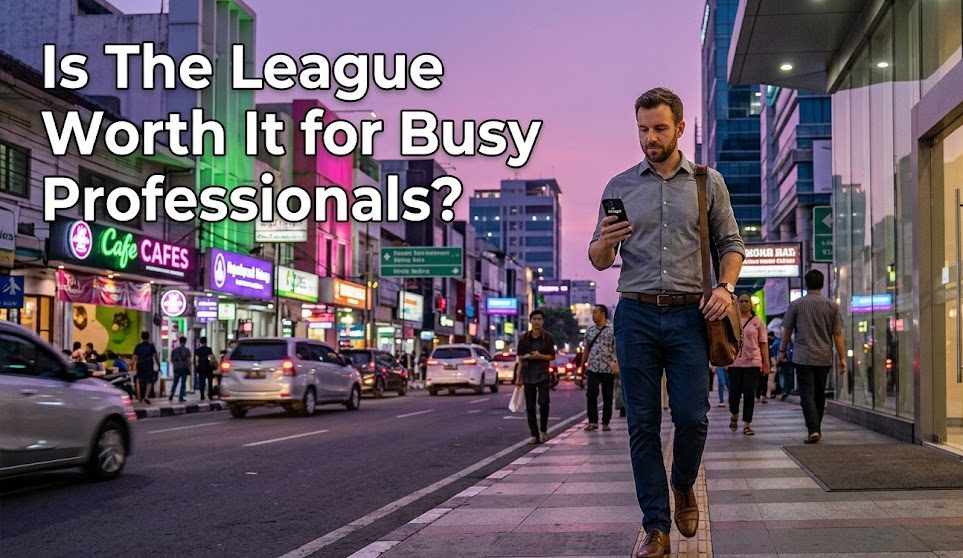
5. Is The League Worth It for Busy Professionals?

This is where the decision becomes practical.
The League offers free access, while paid membership unlocks additional features such as more daily matches, search, profile statistics, a dating Concierge, and tools such as League Tickets. The company also claims subscribers can achieve a 2x to 5x match rate compared with non-subscribers. That figure is a company claim rather than an independent guarantee.
| Factor | The League | Typical mainstream dating app |
| Entry | Application and verification | Usually open registration |
| Discovery | Curated daily batch | Large swipe/feed system |
| Professional context | Strong emphasis | Usually optional |
| Daily volume | Limited | Often much larger |
| Waitlist | Yes | Usually no |
| Matchmaking | Algorithmic plus optional human service | Mostly algorithmic |
| Best advantage | Less noise | More choice |
| Biggest risk | Small or overly selective pool | Too much choice |
The League becomes more compelling if your biggest problem is time.
It becomes less compelling if your biggest problem is simply finding enough compatible people nearby.
That distinction matters more than whether the app feels luxurious.
For comparison, niche dating platforms such as Muzz and Salams also show how strongly dating apps can use identity and shared expectations to narrow the pool. The difference is that The League makes professional ambition and social positioning a much larger part of its identity.
6. The Verdict on The League Is More Complicated Than Its Branding
The League has a genuinely interesting idea: dating does not have to mean endless swiping.
Its waitlist, verification, limited daily batches, preference system, and professional positioning all work toward one goal, reducing the amount of irrelevant dating content users have to process.
That is valuable.
But the app’s biggest selling point is also its biggest philosophical weakness.
Professional success is not romantic compatibility.
A prestigious degree cannot tell you whether someone will communicate when they are upset. A senior job title cannot tell you whether they are emotionally available. And a carefully screened dating pool cannot guarantee chemistry.
The League is therefore best understood as a filtering tool, not a shortcut to love.
If you are a busy professional who genuinely values ambition, education, and a curated dating environment, the model can make sense. If you simply want access to “higher-quality people,” be careful. You may end up paying for a status signal instead of a better relationship experience.
The social capital is real.
The question is whether it improves your dates.
Q&A
Is The League really a dating app for professionals?
Yes, professional and educational backgrounds are a significant part of its positioning. LinkedIn verification can import education and profession information, although the company also offers other verification methods.
How long is The League waitlist?
There is no universal waiting time. The League says it depends on factors including profile completeness, demand in your location, and interest from the community. Subscribers and endorsed applicants can receive priority.
Does everyone need LinkedIn?
No. The League says LinkedIn is its preferred verification method, but Doximity, educational email, and corporate email can also be used.




Leave a Reply