Decoding Hinge Premium Tiers Is HingeX Actually Better Than Hinge Plus?
Dating apps have found a very efficient way to monetize loneliness: put a price on being seen. That is the uncomfortable idea behind hinge premium tiers, where users can pay more for unlimited likes, better filters, enhanced recommendations, and a profile that gets pushed closer to the front of someone else’s queue. Hinge currently offers Hinge+ and HingeX as its two paid subscription options, with the exact packages and billing options presented inside the app.
The interesting question is not whether HingeX has more features. It obviously does. The real question is whether those extra features create enough additional dating opportunity to justify paying more.
Because there is a big difference between getting more control and getting better dates.
Hinge Premium Tiers Put a Price on Visibility and Convenience

Hinge’s paid structure is relatively easy to understand once you strip away the marketing.
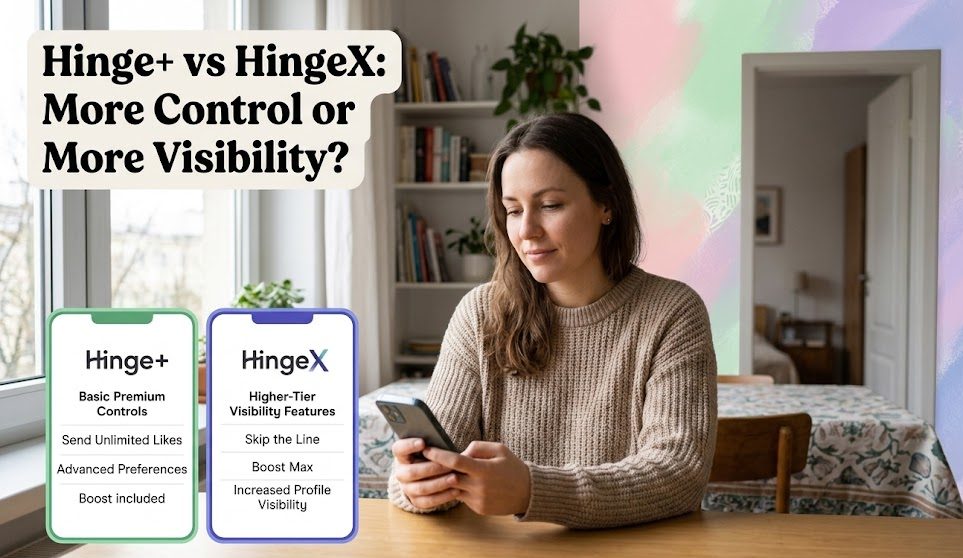
Free Hinge gives you the basic dating experience. Hinge+ removes several restrictions and gives you more control over discovery. HingeX adds another layer designed to improve how quickly your profile gets noticed and how recommendations are presented.
According to Hinge’s January 2026 subscription documentation, the paid tiers currently work like this:
| Feature | Free Hinge | Hinge+ | HingeX |
| Match and message | ✓ | ✓ | ✓ |
| Unlimited Likes | — | ✓ | ✓ |
| See all incoming Likes | — | ✓ | ✓ |
| Advanced preferences | — | ✓ | ✓ |
| Enhanced recommendations | — | — | ✓ |
| Skip the Line | — | — | ✓ |
| Priority Likes | — | — | ✓ |
The important part is that Hinge+ and HingeX are not simply two versions of the same subscription.
Hinge+ mainly gives you more control.
HingeX tries to give you more exposure and stronger recommendations.
That distinction becomes crucial when calculating value.
Hinge+ removes limits rather than magically improving chemistry
The biggest Hinge+ benefits are practical.
You can send unlimited Likes, see all incoming Likes at once, and use advanced preferences.
For someone who regularly hits the free Like limit, this can genuinely make the app less frustrating.
But unlimited Likes are not automatically unlimited opportunities.
If your profile is weak, sending 100 Likes instead of 10 does not fix the underlying problem. It may simply make you spend more time looking at people who are unlikely to respond.
Hinge itself recommends sending quality Likes rather than simply increasing quantity because its recommendation system learns from user activity.
Advanced filters can be useful when your dealbreakers are serious
Hinge+ also gives subscribers more control over preferences.
That can be useful for people with genuine relationship requirements around family plans, children, education, lifestyle choices, or other preferences.
The benefit is not necessarily “more matches.”
It is potentially fewer irrelevant matches.
That is a much more defensible reason to pay.
Someone who knows exactly what they want may get more practical value from advanced filtering than someone simply hoping to receive more attention.
HingeX adds the features that actually change your position
This is where the upgrade becomes more interesting.
HingeX includes Enhanced Recommendations, Skip the Line, and Priority Likes. Hinge describes Skip the Line as an always-on, lighter version of Boost that moves your profile toward the top of other daters’ Discover feeds.
Priority Likes work differently. A Like sent by a HingeX subscriber stays toward the top of the recipient’s Likes You page for seven days. Hinge also notes that Priority Likes look the same as regular Likes to the recipient.
That is a much more aggressive form of monetization.
You are no longer simply paying to remove restrictions from your own browsing experience.
You are paying for a better position inside somebody else’s dating queue.
Hinge+ vs HingeX Comes Down to What You Are Actually Buying
This is where the ROI calculation gets interesting.
Think of the two subscriptions as solving different bottlenecks.
Hinge+ solves a discovery bottleneck.
You see more Likes, send more Likes, and filter profiles more precisely.
HingeX solves an attention bottleneck.
Your profile can be surfaced sooner, your Likes can receive priority placement, and Hinge says its enhanced recommendations use common preferences and recent activity to bring potentially more relevant profiles toward the top of Discover.
That sounds impressive, but there is an important limitation.
Neither tier guarantees that another person will like you back.
More exposure is not the same as a higher match rate
Suppose you normally receive 10 Likes in a month.
If HingeX makes your profile more visible, it might theoretically give you more opportunities to be noticed. But Hinge does not publish a universal percentage saying HingeX subscribers receive, for example, 30% more matches.
That means you cannot honestly calculate a guaranteed return like:
Pay $X → receive Y% more matches.
The available evidence supports a more modest claim: HingeX changes visibility and recommendation mechanics.
It does not establish a fixed improvement in match or date conversion.
That distinction matters enormously for value for money.
The subscription is strongest when your profile is already working
Imagine two users.
User A has terrible photos, generic prompts, a confusing profile, and sends Likes randomly.
User B has strong photos, specific prompts, realistic preferences, and regularly receives interest.
HingeX is much easier to justify for User B.
Why?
Because User B already has something worth distributing more aggressively.
Paying for additional exposure when the underlying profile converts poorly is like buying more advertising for a product nobody wants.
Hinge itself recommends updating photos and prompts, showing interests, using candid images, and sending quality Likes when users are struggling to get matches.
That advice is arguably more important than upgrading.
The Algorithmic Advantage Is Real but Easy to Overestimate
The phrase algorithmic advantage sounds like the kind of thing that can make a dating subscription feel more powerful than it actually is.
Hinge does use recommendation systems to determine which profiles people see. The company is actively developing machine-learning systems around recommendations, ranking, personalization, and dating outcomes.
But paid features do not mean the algorithm suddenly knows who your soulmate is.
Hinge’s own explanation of Enhanced Recommendations says the feature uses common preferences and recent activity to surface profiles it believes users may be more interested in.
That is useful.
It is not clairvoyance.
Enhanced Recommendations are about ranking, not destiny
HingeX may help you encounter profiles that better fit your activity and preferences.
But compatibility remains a human problem.
Someone can tick every box and still have zero chemistry with you. Another person can look completely ordinary on paper and become the most interesting person you have met that month.
No recommendation engine can fully solve that.
This is one reason users should be careful with the psychology of premium dating. The more sophisticated the feature sounds, the easier it is to assume that the platform has a special ability to predict romantic outcomes.
It does not.
Skip the Line is probably HingeX’s clearest premium advantage
If there is one HingeX feature that is easy to understand, it is Skip the Line.
Hinge says the feature keeps your profile more visible in Discover throughout the subscription period. It does not override another user’s preferences, but it helps your profile get noticed sooner.
That is a tangible change.
You are paying for distribution.
The question is whether that distribution is valuable in your particular dating market.
If you live somewhere with thousands of active Hinge users, appearing earlier can plausibly matter more than it would in a small dating pool where people are already seeing most nearby profiles.
Dating App Subscription Spending Should Be Measured by Dates, Not Likes
A common mistake is judging a premium dating product by the number of Likes it generates.
That is the wrong metric.
The actual funnel looks more like this:
Profile exposure → Like → Match → Conversation → Date → Second date → Relationship
A premium feature can affect the first two stages without meaningfully improving the final ones.
That is why a dating app subscription can feel effective while producing disappointing real-world results.
A simple ROI test
Instead of asking “Did I get more Likes?”, track these numbers before and after upgrading:
- Profile views or incoming Likes
- Matches per week
- Conversations that continue beyond a few messages
- Dates arranged
- Dates actually attended
- Second dates
- Money spent per meaningful date
For example, imagine you spend $40 on a premium plan.
Before subscribing:
- 12 matches
- 4 real conversations
- 1 date
After subscribing:
- 20 matches
- 5 real conversations
- 1 date
The app became more active, but your dating outcome barely changed.
That is not necessarily a successful upgrade.
Now imagine:
- 12 matches
- 4 conversations
- 1 date
becomes:
- 18 matches
- 9 conversations
- 3 dates
Now the subscription has a much stronger case.
The point is not the exact numbers. It is the method.
Value for money depends heavily on your bottleneck
If your biggest problem is not seeing enough people, Hinge+ may solve it.
If your biggest problem is not being seen, HingeX may make more sense.
If your biggest problem is getting people to respond, neither subscription necessarily solves it.
If your biggest problem is finding compatible people, better preferences and recommendations may help, but profile quality and realistic standards still matter.
This is why premium dating should be treated like a short experiment rather than a permanent lifestyle expense.
Paid Matchmaking Is Still a Different Product From HingeX
It is tempting to compare HingeX with paid matchmaking because both involve paying for better romantic opportunities.
They are fundamentally different, though.
A subscription gives you additional tools inside an algorithmic marketplace. Paid matchmaking usually involves a human actively helping select or introduce potential partners.
That difference changes the economics.
With a dating subscription, you still do most of the work:
- Browse profiles
- Send Likes
- Write messages
- Maintain conversations
- Arrange dates
- Decide who is worth meeting
With human matchmaking, someone else may perform part of the filtering and introduction process.
That does not make matchmaking automatically better. It simply means you are paying for a different service.
For readers comparing different approaches to relationship-focused dating platforms, our guide to Muzz vs Salams offers another useful example of how identity, filtering, and dating intent can shape an app’s value proposition.
So Is HingeX Actually Better Than Hinge Plus?
Yes, but only in a specific sense.
HingeX is objectively the more feature-rich tier. It includes everything offered by Hinge+ plus Enhanced Recommendations, Skip the Line, and Priority Likes.
But “better” does not mean “better for everyone.”
| Your main problem | Better fit |
| You run out of Likes | Hinge+ |
| You want advanced filters | Hinge+ |
| You want to see incoming Likes more efficiently | Hinge+ |
| You want your profile seen sooner | HingeX |
| You want Priority Likes | HingeX |
| You want Enhanced Recommendations | HingeX |
| Your profile gets little engagement | Fix the profile first |
| You rarely turn matches into dates | Neither should be your first solution |
Hinge also offers weekly, monthly, three-month, and six-month subscription billing options, with subscriptions automatically renewing unless canceled. The available packages and prices are shown inside the app, so users should check their own account rather than relying on a universal price list.
That variable pricing matters when doing the math.
A subscription that feels reasonable for one person can be poor value for another depending on the price shown, dating frequency, local pool, and how effectively the user converts matches into dates.
The Verdict on Hinge Premium Tiers Is Surprisingly Simple
If you are already getting decent engagement but feel limited by Hinge’s free restrictions, Hinge+ is probably the more rational upgrade.
You get the useful stuff without paying specifically for visibility manipulation.
HingeX makes more sense when your profile is already strong and your main frustration is being overlooked in a crowded dating pool. Skip the Line and Priority Likes directly address visibility and placement, while Enhanced Recommendations add another layer of personalization.
But don’t buy HingeX because you think paying more will make the algorithm manufacture chemistry.
It won’t.
The strongest use of premium dating is to remove a genuine bottleneck. If your profile is poor, fix the profile. If your preferences are too narrow, reconsider them. If you never message anyone properly, unlimited Likes will not rescue you. And if you are getting matches but no dates, buying more exposure may simply give you a larger pile of conversations that go nowhere.
The smartest approach is therefore pretty unglamorous: improve the fundamentals first, test premium for a limited period, track actual dates, and cancel if the numbers do not improve.
That is a much better ROI calculator than counting Likes.
Q&A
Is HingeX worth paying for?
It can be, particularly for users who already have a strong profile and want additional visibility. HingeX includes Skip the Line, Priority Likes, and Enhanced Recommendations, but Hinge does not promise a fixed percentage increase in matches or dates.
Is Hinge+ enough for most users?
For many users, yes. Hinge+ provides unlimited Likes, all incoming Likes at once, and advanced preferences. If those are the features you actually need, the extra HingeX features may not justify the additional cost.
Does HingeX guarantee more matches?
No. HingeX can increase visibility through Skip the Line and give Priority Likes additional placement, but those features do not guarantee that another user will Like you back.

Leave a Reply