Dating Culture in Japan Gets a Government Matchmaking App Built Around Trust
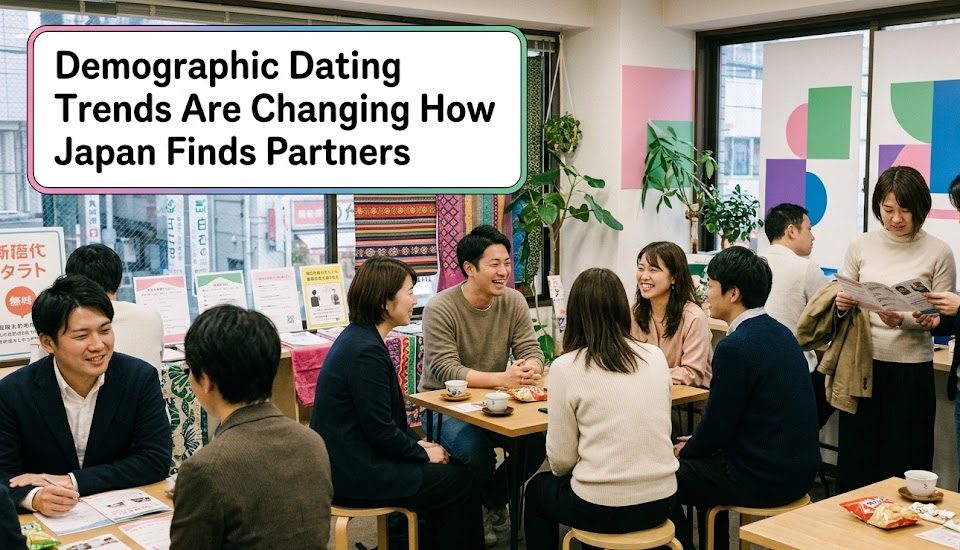
Japan’s demographic problem has become serious enough that local government is now getting involved in something that once belonged firmly to private life: finding a partner. In 2024, Japan recorded just 720,988 births, the ninth consecutive annual decline and the lowest number since records began in 1899. The government has responded with childcare policies and other measures, but Tokyo also decided to tackle one earlier stage of family formation: helping people meet. That makes dating culture in Japan a useful window into a much bigger question.
Why would a city government create an AI matchmaking service, ask users for proof that they are single and verify income, then charge only ¥11,000 for two years? The answer is not simply that Tokyo wants more people swiping. It wants more people taking relationships seriously.
Dating Culture in Japan Is Changing Because Meeting Someone Has Become the Hard Part
Tokyo’s matchmaking project did not appear out of nowhere. Surveys suggest that the problem is not necessarily that young Japanese people have completely rejected marriage. Instead, many struggle to find opportunities to meet potential partners.
A 2024 Children and Families Agency survey of 20,000 people aged 15 to 39 found that 25.1% of married respondents had met their partner through a dating app. Among unmarried respondents, the lack of opportunities to meet someone was the biggest obstacle to marriage.
Another survey found that dating apps had become particularly significant among younger married couples. Among people in their 20s, 24% said they met their spouse through a dating app, matching the proportion who met through work.
That matters because Japan traditionally had plenty of relationship pathways outside apps.
People could meet through:
- school or university
- workplaces
- friends and social circles
- family introductions
- matchmaking services
- local community activities
But work patterns, declining social opportunities and changing attitudes toward marriage have made those routes less reliable for some younger adults.
The Japanese government has also acknowledged that people’s ideas about marriage have changed. The Children and Families Agency has consulted younger generations about what they actually want from relationships rather than simply assuming that marriage follows the old script.
So the government-backed app is less bizarre when viewed from this angle. Tokyo is trying to solve an opportunity problem.
How Tokyo’s AI Matchmaking System Screens People Before They Meet
TOKYO縁結び launched in September 2024 as an AI matchmaking system provided by the Tokyo Metropolitan Government. It is designed for single people aged 18 and above who live, work or study in Tokyo and are looking for marriage.
The system does something noticeably different from the casual swipe-first model.
1. AI Matching Looks Beyond Photos And Basic Filters
Instead of relying only on age, location and appearance, the service uses a values assessment to understand what the user considers important and what they want from a partner.
The AI then recommends people who appear compatible based on those values.
That does not mean the algorithm can predict love. It simply changes the starting point. The pitch is essentially: compatibility first, endless browsing second.
This is where algorithm matchmaking becomes interesting. The system is not being used merely to increase engagement or keep users scrolling. It is being positioned as a tool for helping people make a serious relationship decision.
2. Identity Verification Is Built Into Registration
Tokyo requires users to provide identity-related documentation, including proof of being single and identification documents. The service also uses an online interview to confirm the applicant. Income documentation is part of the verification process as well.
That is a major departure from the anonymous feeling associated with many dating platforms.
The logic is straightforward. If everyone has to clear a verification process before joining, the platform becomes less attractive to people who are married, pretending to be someone else or simply looking for a casual encounter under false pretences.
3. The Price Is Surprisingly Low For A Marriage-Focused Service
When TOKYO縁結び launched, the registration fee was ¥11,000 for two years. Tokyo continues to list the service at that fee in its current 2026 marriage-support materials.
That works out to roughly ¥458 per month if the entire two-year period is used.
The price is important because it reinforces the public-service character of the project. This is not structured like a premium dating subscription designed around upselling boosts or extra visibility.
4. Real People Still Sit Behind The Technology
The AI is not expected to solve everything.
Tokyo also provides consultation support from experienced staff for users dealing with worries or problems during their matchmaking activities. In some circumstances, the service can help arrange meetings without users having to exchange contact details immediately.
That hybrid model is revealing. Tokyo is combining technology with a more traditional matchmaking structure instead of assuming an algorithm can replace human judgment.
Why Serious Relationship Apps Fit Japan’s Marriage Problem Better Than Endless Swiping
The government’s approach makes more sense when compared with the rise of serious relationship apps and services in Japan.
The goal is not simply to increase dates. It is to reduce friction between people who already want a long-term relationship but do not know where to find compatible partners.
The difference can be seen clearly:
| Traditional Swipe Model | Tokyo’s Matchmaking Model |
| Browse large numbers of profiles | Receive selected introductions |
| Photos often dominate first impressions | Values are part of matching |
| Casual and serious users can mix | Marriage intention is explicit |
| Identity checks vary | Verification is required |
| Discovery is user-driven | AI contributes recommendations |
| Engagement can mean more swipes | Success is closer to relationship progression |
This does not automatically make the government model better.
Someone who wants casual dating may find it overly serious. Someone who enjoys meeting unexpected people may dislike having an algorithm narrow the field.
But for people who already know they want marriage, the structure can remove one of the biggest problems with modern dating: wasting time figuring out whether the other person wants the same thing.
That is also why the growth of serious relationship apps in Japan should not be dismissed as simply a trend toward more conservative dating. It can also be a response to practical constraints.
If people have fewer chances to meet partners offline, a service that verifies intentions can become useful.
The Income Proof Is The Strange Part And Also The Most Revealing
Asking someone to prove they are single is understandable.
Asking for income documentation makes the system feel much more intrusive.
Tokyo includes income proof among its registration requirements, alongside identification, proof of single status and a pledge. Current Tokyo materials continue to list those documents.
There is a practical reason for this. Income can be relevant when people are seriously considering marriage and household finances.
But there is also a cultural question.
How much should a dating service know before two people have even met?
That tension sits at the heart of modern digital romance.
Online dating has always involved a strange exchange. Users want enough information to decide whether someone is trustworthy, but they also want room to present themselves naturally. Too little verification creates opportunities for deception. Too much verification can make romance feel like an application process.
TOKYO縁結び deliberately moves toward the second side of that spectrum.
Its model basically says that if the purpose is serious matchmaking, some paperwork is a reasonable price for trust.
Digital Romance Gets A Very Different Meaning When The Government Is Involved

There is something unusual about a public authority entering the dating market.
A private dating company has an obvious commercial incentive. It needs users to keep opening the app, paying subscriptions and interacting with the platform.
Tokyo has a different objective.
The government is dealing with demographic pressure. Japan’s record-low births and long-term population decline create economic and social problems that extend far beyond dating.
Tokyo therefore treats matchmaking as part of a wider policy ecosystem that includes marriage support, consultation, events and family-related initiatives.
That does not mean the app can fix Japan’s birth rate.
It cannot.
People may meet and still decide not to marry. Married couples may decide not to have children. Others may want children but face housing, income, childcare or work-related barriers.
In fact, experts have repeatedly pointed to broader economic and workplace conditions as important factors behind Japan’s demographic situation.
So the app should be understood as one small intervention rather than a demographic miracle machine.
Its more realistic role is to remove one obstacle: not having a realistic way to meet someone who wants the same future.
What Tokyo’s App Says About New Demographic Dating Trends
The most interesting part of this experiment is not really the AI.
It is what the government is willing to acknowledge.
Dating is increasingly part of the infrastructure surrounding marriage.
The numbers support that shift. Dating apps have become a significant route to marriage among younger Japanese couples, while surveys continue to show that lack of opportunities to meet partners is a major barrier.
That creates several broader demographic dating trends worth watching:
- Dating apps are becoming normalised as marriage pathways.
- Verification is becoming a selling point rather than merely a safety requirement.
- Compatibility tools are gaining importance as users become tired of endless browsing.
- Government and private platforms are beginning to overlap in matchmaking support.
- Marriage-focused dating can become more structured without necessarily becoming completely traditional.
There is also a fascinating contradiction here.
Japan is often portrayed as a country where young people are becoming less interested in romance and marriage. The data is more complicated. A substantial share of younger people still say they would like to marry someday, while many report that finding a partner is difficult.
That distinction matters.
Not wanting marriage and not knowing how to meet someone are two completely different problems.
Tokyo is betting that at least some of Japan’s demographic challenge belongs in the second category.
Is Tokyo’s Matchmaking App Actually A Good Idea?
It is easy to make fun of a government dating app. The image of city officials trying to fix romance with paperwork and AI practically writes its own joke.
But the underlying problem is real.
The service has several strengths:
- Clear marriage intent reduces uncertainty.
- Identity checks make deception harder.
- Income verification gives users more reliable information.
- AI recommendations can reduce endless profile browsing.
- Human consultation provides support when technology reaches its limits.
- ¥11,000 for two years makes the service relatively accessible compared with many private matchmaking options.
There are obvious weaknesses too.
Privacy becomes more important when a platform collects sensitive personal documentation. An algorithm can also reproduce the preferences and biases built into the information it receives. And no matching system can guarantee emotional compatibility.
Most importantly, a matchmaking app cannot solve economic insecurity, long working hours or the wider reasons people postpone marriage and children.
Still, the experiment is worth watching.
Tokyo is effectively saying that if modern life has made meeting a partner harder, public policy can at least help create more opportunities for meaningful introductions.
That makes the project much more interesting than a simple government dating app.
Q&A
Why did Tokyo create a government-backed matchmaking service?
Tokyo created TOKYO縁結び as part of broader marriage-support efforts amid declining marriage and birth rates. The immediate goal is to help people who want marriage but struggle to take the first step or find suitable opportunities to meet someone.
Does TOKYO縁結び really use AI to choose your partner?
Yes, but the AI is not presented as a magical predictor of compatibility. It uses results from a values assessment and the values users want in a partner to introduce people who may be compatible.
Could this model become a new direction for dating apps?
Possibly. The combination of identity verification, serious relationship intentions, compatibility-based recommendations and human support offers an alternative to the endless-swipe model. Whether it becomes widely influential will depend on user adoption and, more importantly, whether introductions actually lead to relationships and marriages.



Leave a Reply