Hinge Algorithm Explained and Why the 3 Rose Limit Can Be Your Best Wingman
If you have ever wondered why Hinge puts a limit on one of its most noticeable interactions, hinge algorithm explained through the 3 Rose limit becomes much more interesting when viewed through the psychology of scarcity. The restriction is not simply about having fewer chances to interact. It changes how people evaluate profiles, because a limited action naturally encourages more careful selection.
That matters because dating apps can easily turn into a numbers game. More swipes, more Likes, more profiles and more matches can feel productive, but volume does not automatically create better dates. The 3 Rose system introduces a different question: who is actually worth your strongest expression of interest?
This is where the scarcity principle becomes useful. When something is limited, people tend to pay more attention to how they use it. On Hinge, that can encourage users to move away from automatic swiping and toward deliberate profile selection.
The real value, however, is not assuming that a Rose gives you an algorithmic shortcut. There is no reason to treat it as a guaranteed ranking boost or automatic match. Its more interesting effect is behavioral: it makes you slow down.
1. Hinge Algorithm Explained Through the 3 Rose Limit and Scarcity
The easiest way to understand the Rose system is to separate what the feature does technically from what the limitation does psychologically.
A limited resource changes decision-making.
If every interaction were unlimited, there would be little reason to spend time deciding whether one person deserves more attention than another. You could simply Like everyone who looked interesting and move on.
A limited Rose creates a different mental process.
1. The limit forces you to rank your own interest
Imagine scrolling through 50 profiles.
You might find 10 people attractive, 5 interesting and 2 who genuinely make you curious.
Without a meaningful limitation, those categories can blur together.
With only a small number of Roses available, the decision becomes clearer. The Rose should go toward the person who combines attraction with curiosity and potential compatibility.
That makes the feature useful as a personal filtering mechanism.
You are not necessarily trying to beat the algorithm.
You are improving your own selection process.
2. Scarcity increases perceived attention
Scarcity does not magically make a person more compatible with you. It changes how an action can be perceived.
A normal Like is relatively easy to understand. It says you are interested.
A Rose can feel more deliberate because the sender has fewer opportunities to use that type of interaction.
This creates an important psychological difference.
The recipient may wonder why this particular profile received the stronger interaction. That can create curiosity and make the interaction feel more intentional.
But this should not be confused with a guaranteed advantage in profile ranking.
There is a big difference between:
This action may attract more attention
and:
This action guarantees better algorithmic distribution.
The first is reasonable. The second is something users should not assume without evidence.
3. The real advantage is better decision-making
The strongest argument for the 3 Rose limit is not that it secretly manipulates the algorithm.
It is that it can manipulate your own behavior in a useful way.
You start reading prompts.
You notice lifestyle differences.
You look for conversation hooks.
You stop treating every attractive profile as equally interesting.
That is exactly where the scarcity principle becomes valuable.
Instead of asking how many people you can interact with, you start asking which interactions are actually worth pursuing.
2. Hinge Likes Work Differently When You Separate Attraction From Compatibility
hinge likes are easy to understand when you look at them as the first stage of profile selection. The problem begins when every Like is based on the same shallow criteria.
Someone can be physically attractive without being a good match for your lifestyle, communication style or relationship goals.
A better strategy is to divide your evaluation into layers.
Attraction is only the first filter
Physical attraction matters. There is no need to pretend otherwise.
But it should not be the entire decision.
After the initial attraction, look for evidence of personality.
Ask yourself:
- Does their profile show a sense of humor?
- Do their prompts reveal anything specific?
- Is their lifestyle compatible with mine?
- Do they seem to want the same kind of relationship?
- Is there something I genuinely want to ask them about?
This creates a much stronger filter than judging the first photo alone.
Specificity creates better conversation opportunities
Consider two profiles.
One says:
Loves travel, food and good times.
The other says:
Will happily wake up at 5 AM for a mountain sunrise but refuses to call instant coffee real coffee.
The second profile gives you far more information.
You can disagree about coffee. Ask about the mountain. Talk about travel. Make a joke about waking up at 5 AM.
That is important because the strongest dating profiles do not merely communicate attractiveness.
They create conversation opportunities.
Use the Rose when several signals line up
A useful way to decide whether someone deserves a limited Rose is to look for 3 layers:
- Attraction
You are physically interested. - Curiosity
Something in their profile makes you want to know more. - Compatibility
Their personality, lifestyle or relationship goals appear reasonably aligned with yours.
If only the first box is checked, a normal Like may be enough.
If all 3 are present, the profile has a much stronger reason to receive a limited interaction.
That is the behavioral advantage of scarcity. It encourages you to distinguish between someone you find attractive and someone you actually want to meet.
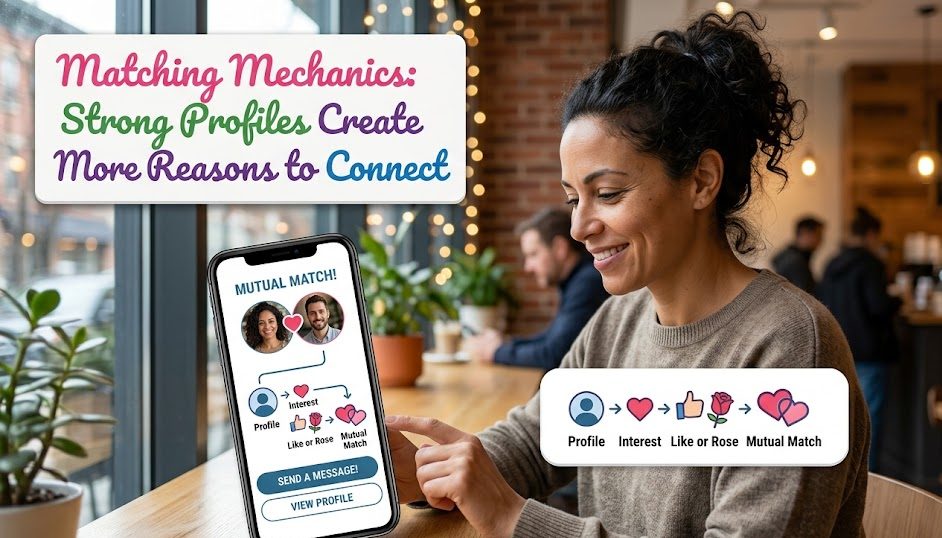
3. Matching Mechanics Depend on More Than Sending a Rose

The matching mechanics of a dating app are easy to oversimplify.
Users often look for one secret variable that explains everything: send more Likes, send more Roses, change your location or modify one photo.
Real dating behavior is more complicated.
A match ultimately requires enough mutual interest for both people to choose each other.
Your profile has to give the other person something to work with
Think of your profile as a decision-making environment.
The person viewing it should be able to answer several questions quickly:
- Who are you?
- What do you enjoy?
- What kind of personality do you have?
- What does spending time with you potentially look like?
- Is there something they can respond to?
This is why profile prompts are important.
A generic answer forces the other person to invent a conversation from nothing.
A specific answer gives them an opening.
That distinction can influence whether a Like turns into an actual conversation.
A Rose cannot repair a weak profile
This is one of the most important points.
If someone sees a poorly lit photo, repetitive pictures and empty prompts, sending a Rose does not automatically solve the underlying problem.
The stronger strategy is to make the profile itself worth responding to.
For example, instead of listing 5 generic interests, show them through details.
Instead of saying you love cooking, mention the dish you make repeatedly.
Instead of saying you travel a lot, show one memorable experience.
Instead of saying you have a good sense of humor, let the writing demonstrate it.
A profile becomes more compelling when the personality is visible rather than simply claimed.
The best Rose is attached to a clear reason
When you send a limited interaction, the profile should already have given you something specific to respond to.
That could be:
- An unusual hobby
- A funny prompt
- A travel story
- A shared interest
- A distinctive opinion
- A lifestyle detail
This makes your interaction more natural.
You are not using the Rose because the app tells you to use it.
You are using it because the profile gave you a reason.
4. Profile Ranking and the Dating App Algorithm Should Not Become an Obsession
The biggest mistake is spending too much time trying to reverse-engineer profile ranking instead of improving the parts of your profile that are actually under your control.
Dating platforms use recommendation systems, but users do not need to know every internal signal to make better decisions.
The same applies to the broader dating app algorithm.
You can spend hours searching for hacks, or you can improve the fundamentals.
What you can actually control
Focus on 4 areas:
| Area | What to improve |
| Photos | Clear, recent and varied pictures |
| Prompts | Specific details that reveal personality |
| Selectivity | Stop interacting with every attractive profile |
| Conversations | Respond to something real in the profile |
These are much more useful than constantly changing settings because you heard a rumor about the algorithm.
Your first photo should remove unnecessary friction
The first image has one basic job: make it immediately obvious who the person is.
Avoid photos where:
- Your face is difficult to see
- Several people appear equally prominent
- Heavy filters change your appearance
- The image is extremely old
- The background overwhelms you
Then use the remaining photos to add information.
One can show your social side. Another can show a hobby. Another can communicate your everyday personality.
The goal is not to create a perfect-looking catalogue.
It is to create a believable picture of your life.
Prompts should make you easier to approach
Good prompts answer a question while creating another one.
For example:
Weak:
I love trying new restaurants.
Stronger:
I judge restaurants by whether the side dish is secretly better than the main course.
The second one creates an obvious opening.
Someone can ask which restaurant proved the theory, disagree with you or tell you their own food rule.
That is far more valuable than simply listing an interest.
Stop trying to appeal to everyone
A profile that tries to be universally attractive often becomes forgettable.
Specificity creates a better filter.
Some people will not care about your obscure hobby.
That is fine.
The people who do care have a stronger reason to interact.
And that is ultimately what you want.
Q&A
Does the 3 Rose limit guarantee more matches?
No. A Rose cannot guarantee a match. Its main value is creating a more deliberate form of interaction and encouraging users to be selective.
Does sending a Rose increase profile ranking?
You should not assume that a Rose automatically gives your profile a ranking advantage. Recommendation systems are more complicated than a single action, and a Rose should not be treated as an algorithm hack.
Should I save all 3 Roses?
No. The point is not to hoard them. Use them when a profile genuinely stands out based on attraction, curiosity and compatibility.
What makes someone Rose-worthy?
Look for more than appearance. A strong candidate usually gives you several reasons to continue: genuine attraction, an interesting personality, compatible lifestyle and an obvious conversation opening.




Leave a Reply