The Ethics Of Using AI Dating Assistants To Write Your Messages
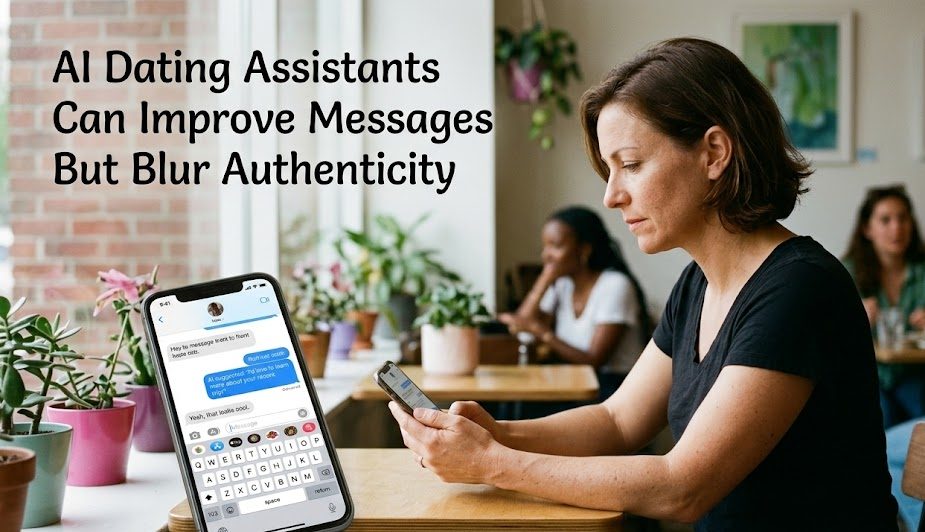
Imagine two ChatGPT bots flirting with each other because neither human on the other side could be bothered to write “Hey, how’s your week going?” That sounds like a Black Mirror joke, but the strange part is that the underlying idea is no longer entirely fictional. AI dating assistants are already being used to suggest openers, rewrite profiles, interpret replies and make awkward conversations sound smoother.
The convenience is obvious. Dating apps can be exhausting, and staring at a blank message box after matching with someone can feel surprisingly difficult. AI can give someone a starting point in seconds. But dating is also one of the few places where the imperfections in a person’s words are part of the information being exchanged.
That creates the real ethical dilemma. If AI helps someone say what they genuinely mean, is that simply a modern version of asking a friend for advice? Or has the conversation stopped being authentic when a machine starts deciding what the person should sound like?
The distinction matters because dating is not only about producing attractive messages. It is about discovering another person’s personality, humour, confidence, awkwardness and communication style. When those things are heavily outsourced, the person receiving the message may be getting a polished version of someone who does not actually exist.
Why AI Dating Assistants Make Dating Messages Feel Better And Riskier
There is a reason people are tempted to use AI for dating. Writing a good message requires several things at once. It has to show interest without sounding desperate, be funny without trying too hard and give the other person something to respond to.
AI is remarkably good at that particular task.
A 2025 peer-reviewed study examining date-request messages found that messages produced with AI assistance were judged more effective, affiliative and explicit by objective evaluators than messages written without AI. The researchers described this as the “Cyrano effect”, referring to situations where a person communicates through words created with substantial help from someone or something else.
That sounds like a win until the person actually has to continue the conversation.
The First Message Can Hide A Real Communication Gap
Imagine someone who normally texts:
“Haha yeah I like that too”
Their AI-assisted version might suddenly become:
“That sounds like exactly the kind of weekend I’d enjoy. What originally got you into it?”
The second message is objectively better for keeping a conversation alive.
But if the person cannot naturally communicate like that, the recipient is learning something inaccurate about them.
The problem is not grammar.
It is identity.
AI Can Remove The Awkwardness That Actually Tells You Something
Awkward messages are not automatically bad messages.
Someone taking ten minutes to figure out how to respond might be nervous. Someone using terrible punctuation might be hilarious in person. Someone who struggles with texting may communicate brilliantly face-to-face.
When AI smooths everything out, those differences disappear.
That can make the conversation more efficient while making the person behind it harder to understand.
A Better Message Does Not Always Mean A Better Match
Research on online dating communication has also found that message characteristics matter. A 2025 study of digital dating messages found that elements such as using a potential partner’s nickname, certain forms of informal language and longer messages could influence successful communication outcomes, while excessive self-disclosure could work against the sender.
AI can optimise for some of those features.
But optimisation is not the same as compatibility.
If a message gets someone a date, yet the personality displayed in the message was largely manufactured, the technology has only moved the mismatch further down the road.
The “Cyrano Effect” Is More Than A Clever Name
The ethical concern has now become a research topic in its own right. A 2026 study on LLM-assisted impression management in online dating describes an “authenticity paradox”: users may feel that AI helps them express their genuine inner thoughts more effectively, while recipients can experience the same assistance as deception once they discover it.
That contradiction is at the heart of the debate.
The sender may think, “AI only helped me say what I already wanted to say.”
The recipient may think, “Then why didn’t you say it yourself?”
Both reactions can be reasonable.
Digital Flirting Changes When The Bot Starts Doing The Flirting
Digital flirting used to mean choosing the right emoji, rewriting a sentence three times and asking a friend whether “haha” sounded too enthusiastic.
Now a chatbot can analyse the conversation and suggest what to say next.
That changes the role of technology from editing communication to participating in it.
The difference is subtle, but important.
Using AI As A Wingman Is Usually The Easier Ethical Case
There is a big difference between asking:
“Can you make this message clearer?”
and asking:
“Read the last 20 messages and decide what I should say so this person becomes more attracted to me.”
The first preserves the user’s intention and voice.
The second begins outsourcing the social interaction itself.
This is why Hinge relationship expert Logan Ury has compared AI’s useful role to that of a wingman rather than a ghostwriter. The Associated Press similarly reported expert advice favouring AI for brainstorming, interpretation and proofreading while warning against letting it completely write dating conversations.
Proofreading Is Not The Same As Persona Building
A useful rule is simple.
If the sentence would still sound like you after AI edits it, the tool is probably assisting.
If you would never have thought, written or spoken the sentence without AI, the tool is probably creating a persona.
For example:
Reasonable assistance
“I really enjoyed talking to you yesterday. Want to grab coffee this weekend?”
AI can clean up punctuation or make it less awkward.
Heavy outsourcing
“Generate five emotionally intelligent responses that maximise attraction while making me appear confident, mysterious and emotionally available.”
At that point, AI is no longer just helping with communication.
It is designing the impression.
Modern Dating Culture Is Already Struggling With Performance
This becomes even more complicated because dating apps already encourage performance.
People choose their best photographs. They rewrite biographies. They research opening lines. They ask friends what to say. They delete messages and start again.
AI is entering a system that was never completely spontaneous in the first place.
That means the argument cannot simply be “AI makes dating fake.”
Dating has always involved impression management.
The more useful question is how much manipulation a person reasonably expects to encounter before the interaction stops feeling honest.
The Other Person Has A Right To Know What They Are Responding To
There is no universal rule requiring someone to announce every AI-assisted sentence.
If someone uses spellcheck, nobody expects a disclaimer.
But disclosure becomes more relevant when AI substantially changes the person’s communication style or generates most of the interaction.
A recipient cannot meaningfully evaluate someone’s communication ability if another system is doing most of the communicating.
Authentic Profiles Matter Because The Same Problem Starts Before The First Message
The issue does not begin in the chat box. It starts with the profile.
Authentic profiles are supposed to give potential matches a rough picture of who someone is. AI can now rewrite bios, recommend photographs and turn a few facts into polished paragraphs.
Dating platforms themselves are moving in this direction. Match Group has been developing AI features across its dating services, including tools intended to help users select photographs, improve profiles and communicate more effectively.
The potential benefit is obvious for people who struggle to present themselves.
The ethical question is where assistance ends.
AI Can Help Someone Who Simply Does Not Know How To Write
Not everyone is naturally good at self-presentation.
Someone may have an interesting life but write an awful dating bio. Another person might have excellent communication skills but struggle with English. Someone else may become anxious when asked to describe themselves.
AI can lower those barriers.
That is not inherently deceptive.
A profile can still represent the person’s real experiences, interests and intentions even if a machine helps organise the wording.
The Problem Starts When The Facts Become Fiction
There is a major difference between:
“I love travelling and have visited six countries.”
and:
“I’m an adventurous, emotionally intelligent storyteller who is always chasing meaningful experiences.”
The second statement may sound attractive while communicating almost nothing verifiable.
AI tends to produce polished abstractions unless users provide concrete details.
That is why a profile written with AI can become impressive but strangely empty.
The Dating Profile Should Still Sound Like A Human Being
A good test is to read the bio aloud.
Would you actually say those words to someone sitting across from you?
If not, rewrite them.
A little awkwardness can be useful. It gives the other person something real to react to.
For example, “I make an aggressively good fried rice at 1 a.m.” tells someone more about personality than “I enjoy creating memorable culinary experiences.”
The first sounds like a person.
The second sounds like LinkedIn discovered romance.
AI Can Also Make Everyone Sound Suspiciously Similar
One of the strangest consequences of generative AI is stylistic convergence.
If thousands of people ask similar models to make their profiles “confident, witty and emotionally mature”, they may gradually start sounding alike.
That creates an ironic problem.
AI is supposed to help people stand out.
Used carelessly, it can make everyone sound professionally charming.
Dating App Algorithms Make The Ethics Problem Bigger Than Messaging
dating app algorithms already influence who appears in front of users, which profiles receive attention and how people navigate potential matches. Adding generative AI creates another layer because technology can now influence not only who people see, but what they say to those people.
This is where efficiency starts colliding with autonomy.
A 2025 legal and ethical analysis of AI-driven dating platforms argued that emotionally persuasive and gamified design can affect user behaviour and decisional autonomy.
The issue is not necessarily that dating platforms are secretly controlling users.
It is that more parts of romantic decision-making are becoming mediated by systems whose logic users cannot fully see.
AI Can Optimise For Replies Rather Than Relationships
Suppose an AI learns that teasing produces more replies.
It might recommend a teasing message.
Then it discovers that delayed responses increase curiosity.
It might suggest waiting.
Then it learns that certain emotional phrases generate longer conversations.
It recommends more of them.
None of those tactics necessarily create a healthy relationship.
They simply optimise engagement.
That distinction should make anyone uncomfortable.
What Works For The App May Not Work For The User
Dating platforms have an obvious interest in keeping people active.
Users, meanwhile, may want to meet one compatible person and leave the app.
Those objectives can overlap, but they are not identical.
An AI dating assistant therefore needs to be treated carefully when it recommends behaviours designed primarily to increase engagement.
The most useful assistant should help someone communicate more clearly, not turn romance into an optimisation game.
The Offline Date Is The Ultimate Reality Check
The biggest problem with AI-assisted dating appears when the conversation moves offline.
A person may have spent two weeks receiving thoughtful, funny and emotionally intelligent messages.
Then they meet.
Suddenly the messages do not sound anything like the person sitting across the table.
The Washington Post reported on daters experiencing exactly this kind of disconnect, including people who became suspicious when exceptionally polished conversations failed to match the person’s behaviour in real life.
That is not simply an awkward first date.
It can damage trust before the relationship has even started.
When AI Stops Being A Wingman And Starts Becoming A Deception
There is no perfect percentage for how much AI assistance is acceptable.
Instead, look at what the tool is actually doing.
| AI use | Ethical risk | Why |
| Spelling and grammar | Low | Your original message remains intact |
| Brainstorming an opener | Low | You still choose and write the final version |
| Rephrasing your own draft | Low to moderate | Voice can change if over-edited |
| Generating most replies | Moderate | The other person may be interacting with AI-shaped communication |
| Generating emotional confessions | High | Feelings may be expressed more convincingly than you can express them |
| Running an entire conversation | Very high | The human relationship is effectively being mediated by a ghostwriter |
A useful boundary is this:
Use AI to remove friction, not to manufacture intimacy.
That means AI can help when you are stuck.
It should not become the person who is effectively dating on your behalf.
Use Your Own Draft First
Write what you genuinely want to say before asking AI for help.
Then ask for something specific, such as:
- “Make this clearer but keep my tone.”
- “Fix the grammar without making it formal.”
- “Give me three shorter versions.”
- “Tell me if this sounds too intense.”
- “What part of this message could be misunderstood?”
Those prompts keep you in control.
Keep Personal Details Out Of The Prompt When Possible
Dating conversations can contain sensitive information.
Names, private stories, addresses, workplace details, relationship history and intimate conversations do not need to be copied into an AI system unnecessarily.
AI relationship research has already highlighted concerns around over-reliance, privacy, manipulation and the limitations of chatbots when people seek emotional guidance. A 2026 Microsoft Research study involving people who used AI for relationship advice found that users actively navigated risks such as sycophancy and overreliance while trying to get useful support.
The safer approach is to remove identifying details and ask for general communication help.
Do Not Let AI Say “I Love You” For You
Some lines should probably remain yours.
Confessions.
Apologies.
Breakup messages.
Declarations of commitment.
Discussions about exclusivity.
Conversations about sex and boundaries.
Those are not merely writing exercises.
They communicate emotional responsibility.
If a machine creates the emotional language while you simply press send, the recipient may reasonably question who they were actually talking to.
The Most Honest Future For AI Assisted Dating Is Probably A Middle Ground
The debate does not need to end with “AI is bad” or “AI makes dating better.”
Both claims are too simplistic.
Used responsibly, AI can help shy daters communicate, reduce anxiety around wording, improve accessibility and make dating less exhausting. Research even suggests that people can respond positively to AI-generated romantic language when the content itself feels high quality and human-like. One 2025 experiment involving 307 participants found that perceived quality and human-likeness mattered more for closeness and romantic interest than whether participants believed the responses were human- or AI-generated.
But that does not remove the ethical problem.
It makes it more interesting.
If a machine can produce words that make us feel closer, should we care who actually wrote them?
The answer is yes when authorship affects trust.
Dating is ultimately a process of discovering another person. A polished message can open the door, but the person behind it still has to walk through.
The best role for AI is therefore closer to a thoughtful wingman.
It can say, “That sentence might come across badly.”
It can suggest, “Try being more specific.”
It can help someone who is nervous get started.
But it should not become the invisible third person in every romantic conversation.
The point of dating is not to produce the perfect message.
It is to find out whether two imperfect humans can actually communicate with each other.
Q&A
Should you tell a dating match that AI helped write a message?
If AI only corrected spelling or lightly edited your own words, disclosure is probably unnecessary. If it generated most of the message or significantly changed your personality and emotional expression, transparency becomes much more reasonable because the other person is evaluating communication that was not entirely yours.
Is using AI for dating messages basically the same as asking a friend for help?
Not exactly. A friend usually knows your personality and gives advice based on a real relationship with you. An AI can generate persuasive language without actually knowing you. The more control you give it over what you say, the further it moves from ordinary advice toward outsourced communication.
Could AI eventually make dating more authentic rather than less authentic?
Possibly. AI could help people express genuine thoughts that anxiety, language barriers or poor writing skills would otherwise hide. The important condition is that the technology should reveal a person’s intentions more clearly rather than inventing a more attractive personality for them.




Leave a Reply