Lox Club vs JSwipe A Deep Dive into Jewish Dating Apps
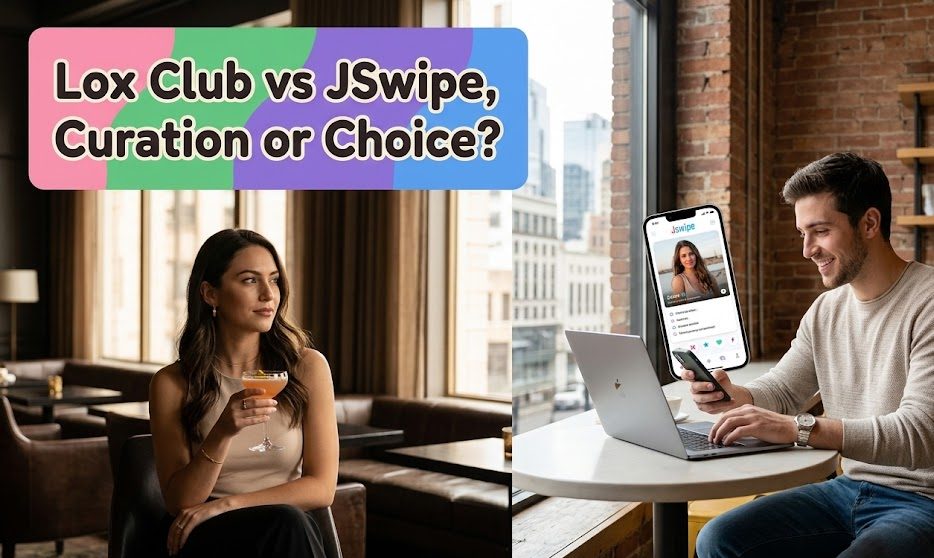
The demand for digital spaces that protect cultural identity without making dating feel like a community directory has created a surprisingly strong market. That is where jewish dating apps become interesting: they are not simply Tinder with a religion filter. They sell something much harder to reproduce on a mainstream platform, namely shared context, cultural familiarity, and a smaller pool where certain relationship expectations are already understood.
Lox Club and JSwipe approach that opportunity from almost opposite directions. Lox Club has built a private, highly curated experience around Jewish culture, membership, matchmaking, and real-world events. JSwipe takes the more familiar swipe-first route, making Jewish dating feel closer to the mechanics people already know from mainstream apps.
The difference matters because the two apps are solving different problems. Lox Club asks whether dating can feel more like joining a private social club. JSwipe asks whether the convenience of swiping can work better when the dating pool already shares an important part of your identity.
Why Lox Club Treats Jewish Dating Apps Like a Private Club
Lox Club’s positioning has never been about simply creating another place for Jewish singles to swipe. Its branding deliberately sits somewhere between a dating app, a social club, and a modern matchmaking service.
The company describes itself as a members club for “Jew-ish” people with high standards, while its community guidelines explain that applicants are reviewed by a membership committee. Applicants who are not accepted can be placed on a waitlist, and membership comes with a fee.
That changes the psychology of the platform.
The Lox Club application is part of the product
On an ordinary dating app, registration is mostly a barrier you want to remove. Lox Club does the opposite.
The application and review process create a feeling that membership itself has value. The company says its committee checks applications before acceptance, while its current FAQ says applicants can generally expect a response within one to two weeks.
That is classic scarcity marketing, but it also has a practical dating function: people who complete a longer application and pay for membership may be more intentional than someone who downloads an app simply because they are bored on a Tuesday night.
It sells culture without demanding religious uniformity
An important detail is that Lox Club is culturally Jewish rather than strictly religious.
Its FAQ explicitly says non-Jewish people can apply because the platform is built around a cultural vibe rather than a requirement that every member meet one religious definition of Jewish identity.
That makes the platform potentially attractive to people who care about Jewish family life, humor, food, traditions, community, or shared cultural references but do not necessarily want a highly religious matchmaking environment.
Matchmaking is where Lox Club moves beyond swiping
Lox Club added a dedicated matchmaking service in 2024, extending its model beyond algorithmic discovery. The Los Angeles Times reported that the service had a waitlist of more than 10,000 people in early 2025, with the company pointing to its established Jewish community as an advantage for finding curated introductions.
That is a significant strategic move.
Instead of asking users to do all the work, Lox Club can position itself as the person in the room who says, “I know someone you should meet.”
That is cultural matchmaking turned into a product feature.
JSwipe Keeps the Swipe Familiar and Makes the Jewish Filter Matter

JSwipe comes from a different generation of dating-app thinking. Launched in 2014, it took the swipe mechanic that had become popular in mainstream dating and applied it specifically to Jewish singles. The app still presents itself as a Jewish dating service and remains available on iOS and Android.
That simplicity is actually its biggest advantage.
The experience feels immediately familiar
JSwipe’s basic system is straightforward: like or pass on profiles, match when interest is mutual, and start chatting. Its current help documentation also lists features such as Super Swipe, Swipe Note, Passport, Explore, and Most Eligible.
For someone who already understands Tinder-style dating, there is very little learning curve.
That makes JSwipe more accessible than Lox Club’s membership-club concept.
Jewish preferences are integrated into the dating experience
JSwipe’s value comes from reducing the amount of cultural explanation required before a conversation even starts.
Instead of matching with a random person and discovering several dates later that your expectations around Jewish identity are completely different, users enter an environment where Jewish identity is already part of the context.
The distinction should not be overstated, though. Jewish identity is not one uniform experience, and an app cannot automatically solve differences around denomination, observance, family expectations, geography, or relationship goals.
The app can narrow the pool. It cannot guarantee compatibility.
JSwipe is still built around volume
This is where JSwipe feels closer to mainstream dating.
The platform’s support pages acknowledge that users can run out of nearby profiles and may need to expand their criteria. Passport can also allow users to swipe in another location.
That tells you something important about the business model: the size and activity of the dating pool still matter enormously.
A beautiful interface and highly specific filters mean little if there are not enough active people within a realistic dating distance.
For users outside major Jewish population centers, that can become the biggest weakness of niche dating apps.
Lox Club vs JSwipe When Exclusivity Actually Changes Dating
The most useful way to compare these platforms is not by asking which one has the prettier interface. The better question is what kind of dating environment each company is trying to manufacture.
| Factor | Lox Club | JSwipe |
| Core identity | Private Jewish cultural club | Jewish swipe-based dating app |
| Entry | Application and membership model | More conventional app registration |
| Discovery | Swiping plus matchmaking | Primarily swipe and match |
| Offline experience | Members-only events | Primarily digital dating |
| Matchmaking | Dedicated human matchmaking service | App-first discovery, with matchmaking now offered separately |
| Atmosphere | Curated and selective | Casual and familiar |
| Best fit | People wanting intentionality and exclusivity | People wanting a simple Jewish dating pool |
Lox Club’s official materials emphasize curated membership, personalized matchmaking, and IRL events. JSwipe’s current product documentation emphasizes swiping, matching, messaging, location tools, and premium features.
That is why comparing them only as apps misses half the story.
Lox Club is selling access as much as dating
A private club has an obvious psychological advantage: being accepted feels like a form of validation.
That can make the community feel more valuable, but it also creates a trade-off. A smaller, carefully controlled pool can feel more relevant while simultaneously limiting the number of people available to date.
Lox Club itself acknowledges that matches are not always local and says its system prioritizes compatibility rather than proximity.
For someone living in New York, Los Angeles, Miami, Chicago, Boston, or another major Jewish population center, that may be manageable. For someone in a smaller market, distance can quickly outweigh cultural compatibility.
JSwipe makes fewer promises and gives users more control
JSwipe is easier to understand.
You build a profile, set preferences, browse people, and decide who interests you. Its current help center documents search filters and tools for expanding the pool when matches become scarce.
That makes it less romantic as a concept but potentially more practical.
If you want to browse a large pool and make your own decisions, JSwipe has the advantage. If you want the platform to do more of the filtering before you even begin, Lox Club has the stronger proposition.
This is also why exclusive dating networks can be attractive but frustrating at the same time. Exclusivity sounds great until the person you actually want to meet lives three states away.
The Real Business Model Behind Curated Matches
There is a bigger startup lesson hiding underneath this comparison.
Religion, culture, profession, lifestyle, and even education can all become useful filters in dating because they reduce uncertainty. A mainstream dating app has to serve an enormous variety of people. A focused platform can make a narrower promise.
That narrow promise can be surprisingly valuable.
A smaller audience can support higher-value services
JSwipe’s history shows how quickly a focused dating product can find an audience. After launching in 2014, it reportedly reached hundreds of thousands of users within its first few years and was acquired by Spark Networks in 2015.
Lox Club takes the opposite monetization route.
Instead of maximizing the number of people who can join, it puts more emphasis on membership, curation, events, and human matchmaking. Its current FAQ lists paid membership plans, while its community guidelines say membership fees help support the curated experience, events, and matchmaking service.
JSwipe also shows how a dating brand can expand beyond the basic app. Its current matchmaking service offers human-guided packages, including a Match Concierge starting at $750 per month and a Premier Matchmaking service starting at $2,000 per month.
Those numbers reveal something bigger than premium pricing.
The real premium product is not the swipe.
It is the reduction of uncertainty.
The more specific the problem, the easier the value proposition becomes
A person may tolerate hundreds of mediocre profiles on a mainstream app because the service is broad and often inexpensive.
But if someone says:
- I want to date someone who understands my culture.
- I want someone who shares my family expectations.
- I want a Jewish partner.
- I want someone serious about a long-term relationship.
- I do not want to spend hours filtering through irrelevant profiles.
then a specialized platform can suddenly make economic sense.
This is where curated matches become more than a marketing phrase. The platform is charging users to reduce the amount of searching they have to do themselves.
Which One Makes More Sense for Different Jewish Singles?
There is no universal winner because the apps are aimed at different dating personalities.
Choose Lox Club if you want dating to feel more intentional
Lox Club makes the most sense for someone who values:
- A smaller and more curated community
- Jewish cultural context
- Membership exclusivity
- Human matchmaking
- Offline events
- A more premium dating experience
The strongest argument for Lox Club is not that every match will be better. It is that the company is trying to improve the environment in which matching happens.
That distinction matters.
Choose JSwipe if you prefer to do the searching yourself
JSwipe is a better fit if you want:
- A familiar swipe interface
- More direct control over discovery
- Jewish-specific dating preferences
- Location-based browsing
- A less formal entry experience
- Features that feel familiar to mainstream dating-app users
The app is especially appealing to people who do not want the dating experience to feel like an interview or application process.
Consider geography before paying for either
This may be the most practical advice in the entire comparison.
Check the actual pool in your city before deciding that an app is worth paying for. A specialized dating service only works when specialization and availability meet.
Lox Club currently lists major North American Jewish communities including New York, Los Angeles, Miami, Austin, Philadelphia, Chicago, Boston, Washington, D.C., and San Francisco among its flagship markets.
JSwipe also provides tools such as Passport for people who want to explore another location, which can be useful if your local pool is thin.
In other words, do not confuse a better filter with a bigger pool.
The Verdict Is Really About How Much Work You Want the App to Do
Lox Club and JSwipe represent two different answers to the same dating problem.
JSwipe makes the familiar swipe model more relevant by placing it inside a Jewish dating environment. Lox Club goes further by trying to control who enters the community, how members meet, and how much help they receive along the way.
That makes Lox Club the more distinctive product, but not automatically the better dating app.
If you enjoy browsing, messaging, and making your own decisions, JSwipe’s simplicity is a genuine advantage. If you are exhausted by endless swiping and want a smaller community with events and human matchmaking layered on top, Lox Club has the more compelling proposition.
The larger startup lesson is even more interesting. Dating platforms do not necessarily become valuable by becoming broader. Sometimes they become valuable by becoming more specific.
A person who wants “someone nice” has millions of options.
A person who wants someone who understands their culture, values, family expectations, and relationship goals has a much harder problem.
The winning product is the one that makes that narrower search feel easier without pretending that shared identity automatically creates chemistry.
Q&A
Is Lox Club only for Jewish people?
Not strictly. Lox Club describes itself as culturally Jewish and says non-Jewish people can apply. The platform is designed around Jewish culture, but it does not require every member to fit one religious definition of Jewish identity.
Is JSwipe still active?
Yes. Its official website and support center are currently active, with documentation covering matching, messaging, filters, subscriptions, Passport, and other features.
Which app is more exclusive?
Lox Club is clearly more exclusive in its membership structure because applications are reviewed before acceptance and membership is paid. JSwipe is much closer to a conventional app-based dating model.



Leave a Reply